

CNC Tube Bending Machine
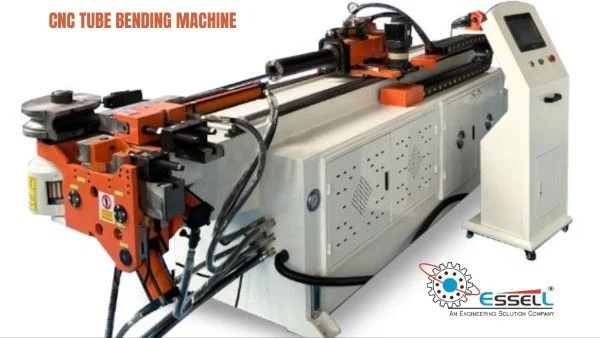
A tube can be straight, but the finished component often cannot be. From automotive structures to industrial assemblies, many products depend on tubes being formed into precise shapes and repeatable curves. A CNC Tube Bending Machine gives manufacturers greater control over this transformation, helping turn tube geometry into a consistent production process.
ESSELL’s CNC tube bending solutions are designed for applications where repeatability, controlled movement, dimensional consistency, and production efficiency are important.
When Tube Geometry Becomes Complex
Simple manual bending may work for occasional jobs, but production becomes more demanding when a component includes several bends at different positions.
The challenge is not simply achieving an angle. The bend must occur at the correct location, with the required radius, orientation, and sequence.
CNC technology allows these parameters to be managed through programmed machine control. Once the bending process is established, the same sequence can be reproduced across multiple components with considerably less dependence on manual positioning.
What CNC Control Brings to Tube Bending
A CNC tube bending machine can provide manufacturers with greater control over repetitive forming operations.
Repeatable Components
Programmed bending sequences help produce components with consistent geometry across production batches.
Controlled Bend Positioning
Accurate positioning between bends is essential for multi-bend components and complex tubular assemblies.
Reduced Operator Dependency
The machine handles programmed movements, reducing the amount of repetitive manual adjustment required during production.
Streamlined Production
A standardized bending cycle can make repetitive manufacturing more organized and efficient.
Better Process Consistency
Using defined parameters helps reduce variations that may occur when every component is manually measured and formed.
Where CNC Tube Bending Is Used
CNC tube bending technology can support a wide range of manufacturing requirements, including:
- Automotive and auto-component fabrication
- Industrial machinery
- Tubular furniture
- Agricultural equipment
- Engineering components
- Structural tube assemblies
- Fabrication workshops
- Specialized tube products
The actual machine configuration can be selected according to the tube dimensions, material, geometry, and production requirements.
Selecting the Right CNC Tube Bending Machine
The most suitable machine depends on the component being produced. Before investing in a CNC tube bending solution, manufacturers should assess:
Tube Diameter:
Determine the maximum and minimum tube sizes required for production.
Material:
Different materials respond differently to bending and may require application-specific tooling.
Wall Thickness:
Tube thickness affects the bending process and tooling requirements.
Bend Radius:
The required centerline radius is an important factor when determining machine suitability.
Number of Bends:
Components with multiple bends may require more advanced control and positioning.
Production Quantity:
The machine should match the expected workload and production frequency.
Component Geometry:
The overall length, bend orientation, spacing, and shape should be considered before selecting the machine.

Consistency Starts Before the Bend
The quality of a bent tube depends on more than the bending force applied to it. Tooling, material characteristics, machine setup, positioning, and programmed parameters all influence the final component.
That is why a CNC tube bending machine should be considered as part of the complete manufacturing process—not simply as a replacement for manual bending.
When the machine, tooling, material, and component design are properly matched, manufacturers can establish a more predictable production workflow.
From Digital Instructions to Real-World Components
One of the major strengths of CNC technology is its ability to convert defined bending requirements into a repeatable machine sequence.
Instead of manually recreating every bend, the operator can work with an established process. This is especially valuable when manufacturing batches of components that need to maintain the same dimensions and shape.
A Better Approach to Tube Fabrication
For businesses producing tubular components regularly, consistency can have a direct impact on productivity, inspection, rework, and material utilization.
An ESSELL CNC Tube Bending Machine is intended to help manufacturers bring greater structure and control to tube-forming operations—whether the requirement involves straightforward bends or more demanding multi-bend components.
Have a specific tube, material, bend radius, or component design? Connect with ESSELL to discuss your application and find a CNC tube bending solution suited to your production needs.